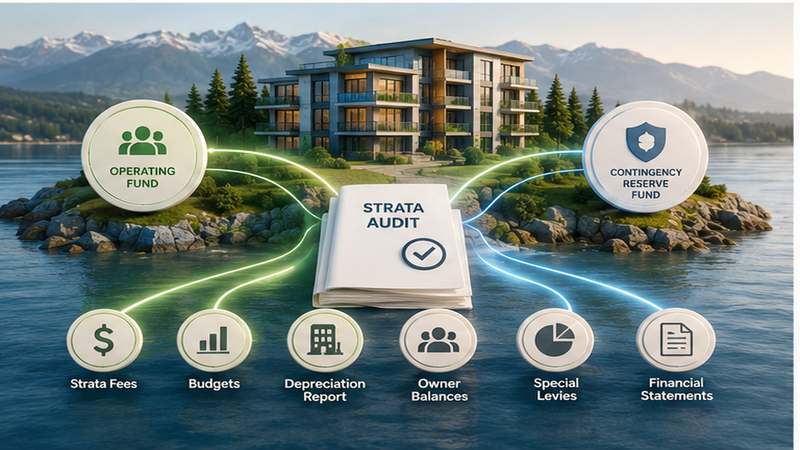
A BC strata file is built around the operating fund, the contingency reserve fund, strata fees and owner approvals. Generic working papers handle the shell; the strata-specific middle still needs its own structure.
BC strata audit working papers have to reflect how a strata corporation is actually run. A strata is not a small company with shareholders. It has strata lots, strata fees, an operating fund, a contingency reserve fund (CRF), an annual budget approved by the owners, special levies and money owing from owners. A general audit platform can hold the trial balance, the leadsheets, the review sign-offs and the report. What it usually does not do is organize the strata-specific middle of the file, and that is where most of the hours on a strata engagement are spent.
Key takeaways
- Part 6 of the Strata Property Act sets the structure your working papers should follow: operating fund, CRF, strata fees, budget, special levies and borrowing.
- The Act regulates strata finances in detail but contains no audit requirement, so confirm where the engagement comes from before you plan.
- CRF spending, the CRF minimum contribution and special levy segregation are statutory areas every strata file should test.
- Strata fees can be recalculated lot by lot from the approved budget, which makes revenue one of the most precise tests in the file.
- The CPA still reviews evidence, concludes on each area and forms the opinion; better structure only removes the rebuilding.
What the Strata Property Act puts in the file
Part 6 of the Strata Property Act is the starting point for any BC strata audit plan. Section 92 requires the strata corporation to establish, and the owners to contribute to by means of strata fees, an operating fund for common expenses that usually occur once a year or more often, and a contingency reserve fund for common expenses that usually occur less often than once a year or do not usually occur.
Around those two funds, Part 6 also deals with:
| Area | Where it sits in Part 6 | What it means for the file |
|---|---|---|
| Operating fund and CRF | Section 92 | Two funds to present and test separately |
| Depreciation report | Section 94 | Context for CRF contributions and spending |
| CRF management | Section 95 | Separate accounting, permitted investments, interest stays in the CRF |
| CRF spending | Sections 96 and 98 | Each payment needs the right approval or emergency basis |
| Strata fees | Section 99 | Fees calculated from the budgeted contributions |
| Budget | Section 103 | Approved by majority vote at each AGM, sent with a financial statement |
| Special levy | Section 108 | Levy money accounted for separately and used for its purpose |
| Borrowing | Section 111 | Needs a 3/4 vote resolution |
| Money owing | Section 112 | Notice requirements behind owner balances |
The Strata Property Regulation adds detail, including what the strata's financial statement must contain. Check the current rules for the exact contents before you agree the presentation with council.
Where the audit obligation comes from
Part 6 contains no requirement for a strata corporation to have its financial statements audited, and the province's guidance encourages stratas to consider an audit or an independent review rather than requiring one. When a strata is audited, the obligation usually comes from its bylaws, an owner resolution or the approved budget. Read the source before you sign the engagement letter, because it may name the engagement type, the period or the reporting deadline. Our British Columbia page summarizes how strata files are handled in the software.
Why generic working papers leave a gap
General audit software is built to be flexible. That flexibility is useful, but it means the tool treats a strata much like any other small entity. It will not, on its own, know that the CRF must be accounted for separately, that each CRF payment needs an approving resolution, or that strata fee revenue can be recalculated from the budget.
So the team fills the gap by hand: a document checklist in a spreadsheet, minutes chased by email, fund schedules rebuilt and account names remapped every year. None of that is judgment. It is setup, and it repeats on every engagement.
Strata-specific procedures worth building in
Contingency reserve fund
The province states that since November 1, 2023, the annual CRF contribution must be at least 10% of the total budgeted operating fund contribution. Confirm the budget met that minimum and that the contributions were actually transferred. Section 95 requires CRF money to be accounted for separately, with interest and income earned on it becoming part of the fund, so reconcile each CRF bank and investment account to the fund in the ledger and confirm the balances directly.
Under section 96, a majority vote is enough for some CRF spending, such as obtaining a depreciation report or carrying out work it recommends, and a 3/4 vote is required in almost all other cases, unless the spending is an emergency expenditure under section 98. Trace each CRF payment to the resolution that approved it.
Strata fees
Strata fees are generally shared by unit entitlement under section 99 and the regulations. Recalculating each lot's monthly fee from the approved budget, then comparing it to what was billed and posted, turns the largest revenue line into a precise test rather than a reasonableness check.
Special levies
Section 108 lets the strata raise money by special levy. Levy money must be accounted for separately and used for the purpose stated in the resolution. Test receipts against each owner's share and spending against the stated purpose, and look at how any surplus was dealt with.
Budget, minutes and the depreciation report
Section 103 requires the budget to be approved by majority vote at each AGM and accompanied by a financial statement. Agree the budget in the file to the approved version in the minutes. Read the most recent depreciation report for context on CRF spending and contributions; for the rules on how often one is needed, see our article on depreciation reports in BC.
Owner balances and borrowing
Owner receivables need ageing and collectability work, with section 112 in mind for money owing. Borrowing should be supported by a 3/4 vote resolution under section 111 and the loan terms.
How Condo Audit Pro supports the strata file
Condo Audit Pro gives the strata council or manager a client portal with a checklist that adapts to the building, so the CPA can see what is outstanding instead of tracking it in a spreadsheet. The software reads the trial balance, general ledger and bank statements, foots the trial balance and ties it to the ledger account by account, compares bank statements to the cash accounts, and tests every lot's fees month by month against the approved schedule.
Leadsheets arrive with procedures pre-filled from the firm's own wording, with evidence filled in where the software can show it, and any text the CPA edits is visibly marked. The financial statements are fund-based, operating and reserve, with BC-specific wording. Sign-offs, independence, the opinion and the close always stay with the CPA.
Common questions
Is a BC strata corporation required to have an audit?
Not under Part 6 of the Strata Property Act, which contains no audit requirement. An audit becomes required when the strata's bylaws, an owner resolution or another binding decision calls for one.
What should a strata CRF working paper hold?
The CRF bank and investment confirmations, a reconciliation of each account to the fund balance, support for the minimum contribution, and the approving resolution or emergency basis for each CRF payment.
Can a strata fee test cover every lot?
Yes. Fees come from the approved budget and each lot's share, so every lot's monthly fee can be recalculated and compared to what was billed.
Does the CPA still conclude on each area?
Yes. Pre-filled procedures and evidence are a starting point. The CPA reviews, edits, concludes on each leadsheet and signs the report.
BC strata files share the same structure year after year, which is exactly why they reward a workflow built for them. Watch a complete audit walkthrough, or see how Condo Audit Pro works for CPA firms and book a time on one of your own strata files.
Written by the Condo Audit Pro team at Yabuh Ltd. The platform is the result of 1,000+ hours of development, and its audit logic is built on Canadian Auditing Standards (CAS), ASNPO and each province’s condominium statute. The firm’s own CPA performs and signs the audit. More about how we built it.
The platform that prepares the file. The CPA decides.
Built for condominium and strata audits across Alberta, BC, and Ontario. Document collection, GL matching, two-fund classification, fee testing — handled before the CPA opens the file.