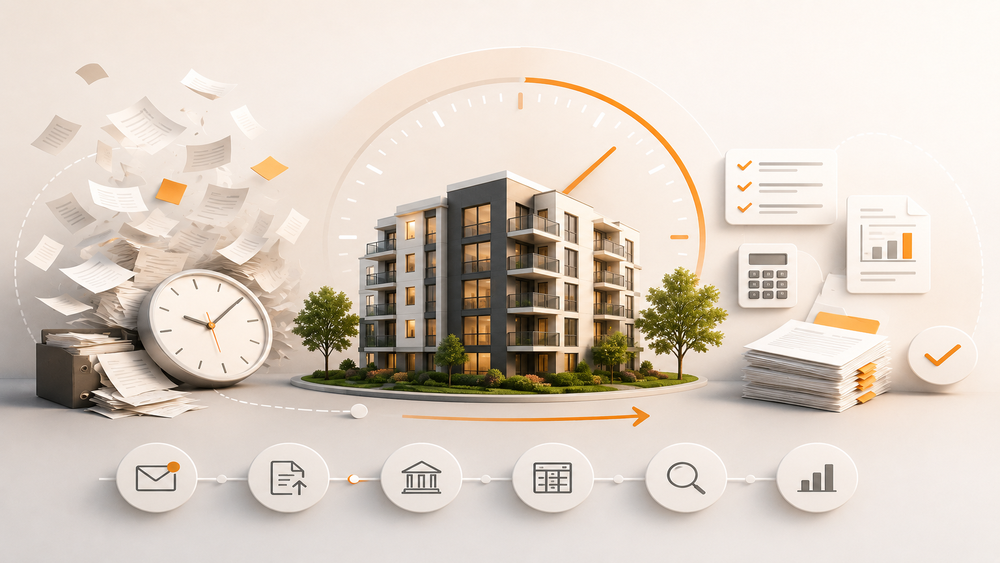
Condominium and strata audit hours rarely disappear into professional judgment. They go into chasing documents, re-keying figures, matching the ledger, mapping accounts, testing fees and rebuilding the same schedules every year.
Ask a CPA firm why condo audits take so long and the answer is rarely "the opinion." The time goes in before the opinion: collecting documents, checking they are complete, tying the general ledger to the trial balance and the bank, testing invoices, mapping accounts, testing fee revenue, rebuilding fund schedules and preparing working papers. That preparation layer is what limits how many condominium and strata audits a firm can take on in a season, whether the files are in Alberta, British Columbia or Ontario.
Key takeaways
- The bottleneck on condo and strata files is preparation, not the CPA's judgment.
- Six time sinks repeat on almost every file: documents, re-keying, GL matching, mapping, fee testing and rebuilding last year's structure.
- Each one has a practical fix, from a complete document request to exception-based matching.
- The fund structure differs by province, so the file must present the right funds under the right Act.
- Structure removes rework; it does not remove the CPA's review, sign-offs or opinion.
The judgment is not the bottleneck
An experienced CPA already knows how to think through a condominium or strata audit. The operating fund matters. The reserve fund, or in BC the contingency reserve fund, matters. Owner fees, arrears, budget variances, minutes, the reserve study and invoice support all need attention.
The problem is getting the file ready for that thinking. Before the CPA can focus on risk and evidence, someone has to turn documents from different people, in different formats, arriving at different times, into a clean file.
Where the hours actually go
1. Chasing documents
Many audits start with scattered emails. The manager sends bank statements; the minutes come later; invoices arrive in pieces. One file is missing, another is the wrong year, a third has been replaced by a newer version. Every missing item is another email, and every email slows the file.
The fix: send a complete, building-specific request list at planning, and keep one visible list of what is still outstanding.
2. Re-keying information
A condo file mixes PDFs, Excel and CSV exports, invoices, bank statements, trial balances, budgets, minutes, reserve documents and prior-year statements. When those files do not talk to each other, staff become the bridge, reading a figure in one place and typing it into another. That is not judgment. It is preparation risk, because every retyped number is a chance for error.
The fix: work from the ledger and bank data directly, and bring prior-year figures forward rather than retyping them.
3. Matching the ledger to support
The ledger has to agree to the trial balance, the bank and the invoices. Most lines are routine, but the team still has to identify what agreed, what agreed only in part and what needs investigation. Across hundreds or thousands of lines, that is slow.
The fix: tie the trial balance to the ledger account by account first, then compare bank to cash month by month, then match sampled invoices to postings. Review the exceptions, not every line. Audit evidence still has to meet CAS 500, Audit Evidence; structure changes how the work is organized, not the standard it meets.
4. Mapping accounts every year
Management company systems use account names that rarely match financial statement wording. One file says repairs, another R&M, another building maintenance, and operating and reserve items are split differently. Without a record of last year's decisions, staff map the same accounts again.
The fix: keep last year's mapping and comparatives as the starting point, and change only what actually changed.
5. Testing owner fees
Condo revenue is not ordinary sales. It depends on each unit's share, set by unit factor in Alberta, unit entitlement in BC and the proportions in the declaration in Ontario, along with monthly fees, arrears and special assessments or levies. A reasonableness check on total revenue can hide offsetting errors.
The fix: recalculate every unit's monthly fee from the approved budget and compare it to what was billed and posted.
6. Rebuilding the same structure
The same checklist, the same fund presentation, the same leadsheets, the same client questions: rebuilt every year for a building that has barely changed. Audit documentation still has to stand on its own under CAS 230, Audit Documentation, but last year's file is a valid starting point for this year's.
The fix: roll forward openings, the unit roster and last year's answers as suggestions, and confirm or change them.
The fund structure differs by province
| Province | Governing Act | Reserve fund | Audit requirement |
|---|---|---|---|
| Alberta | Condominium Property Act | Reserve fund in a separate bank account | Depends mainly on the bylaws; check the current rules |
| British Columbia | Strata Property Act | Contingency reserve fund, accounted for separately | None in the Act's Part 6; comes from bylaws or owner resolution |
| Ontario | Condominium Act, 1998 | Reserve fund | Auditor appointed by owners, with a limited exemption for small corporations |
The cost side of these differences is covered in our article on what drives condo audit cost in Alberta.
Why general audit tools do not fully solve this
General audit platforms help with trial balances, working papers, sign-offs and report structure. Condo and strata work has a middle layer they were not built around: property manager uploads, unit-based fee testing, fund presentation, invoice-to-ledger matching, reserve documents and province-specific statements. When that layer lives in spreadsheets and email beside the audit file, the hours follow.
What actually shortens a condominium audit
Condo Audit Pro was built for that middle layer; see how it works. The board or manager uploads documents to a client portal with a checklist that adapts to the building, and the CPA sees what is outstanding. The software reads the trial balance, ledger and bank statements from Excel, CSV and bank PDF statements, ties them account by account, matches sampled invoices to postings and tests every unit's fees month by month against the approved schedule.
Leadsheets arrive with procedures pre-filled from the firm's own wording and evidence filled in where the software can show it, with edited text visibly marked. Differences become proposed adjusting entries that the CPA accepts or dismisses. In year two, openings, the unit roster and last year's answers come forward as suggestions. Sign-offs, independence, the opinion and the close always stay with the CPA.
Common questions
Why do condo audits take longer than expected?
Usually because documents arrive late or incomplete and the file has to be assembled by hand before review can start. The judgment itself is rarely the cause.
Is GL matching really the biggest time sink?
On many files it is one of the largest, because every routine line has to be sorted to find the few exceptions. Exception-based matching keeps the effort on what differs.
Do strata audits in BC take the same work as Ontario condo audits?
The mechanics are similar, but the fund names, the source of the audit obligation and the approval rules differ, so the file must follow the right Act.
Does structuring the work change audit standards?
No. The Canadian Auditing Standards still apply in full. Structure changes how the evidence is gathered and organized, not what it must show.
If the season will not stretch to fit your condo and strata work, the answer may be the preparation layer rather than more staff. Watch a full audit walkthrough, or see what Condo Audit Pro does for CPA firms.
Written by the Condo Audit Pro team at Yabuh Ltd. The platform is the result of 1,000+ hours of development, and its audit logic is built on Canadian Auditing Standards (CAS), ASNPO and each province’s condominium statute. The firm’s own CPA performs and signs the audit. More about how we built it.
The platform that prepares the file. The CPA decides.
Built for condominium and strata audits across Alberta, BC, and Ontario. Document collection, GL matching, two-fund classification, fee testing — handled before the CPA opens the file.