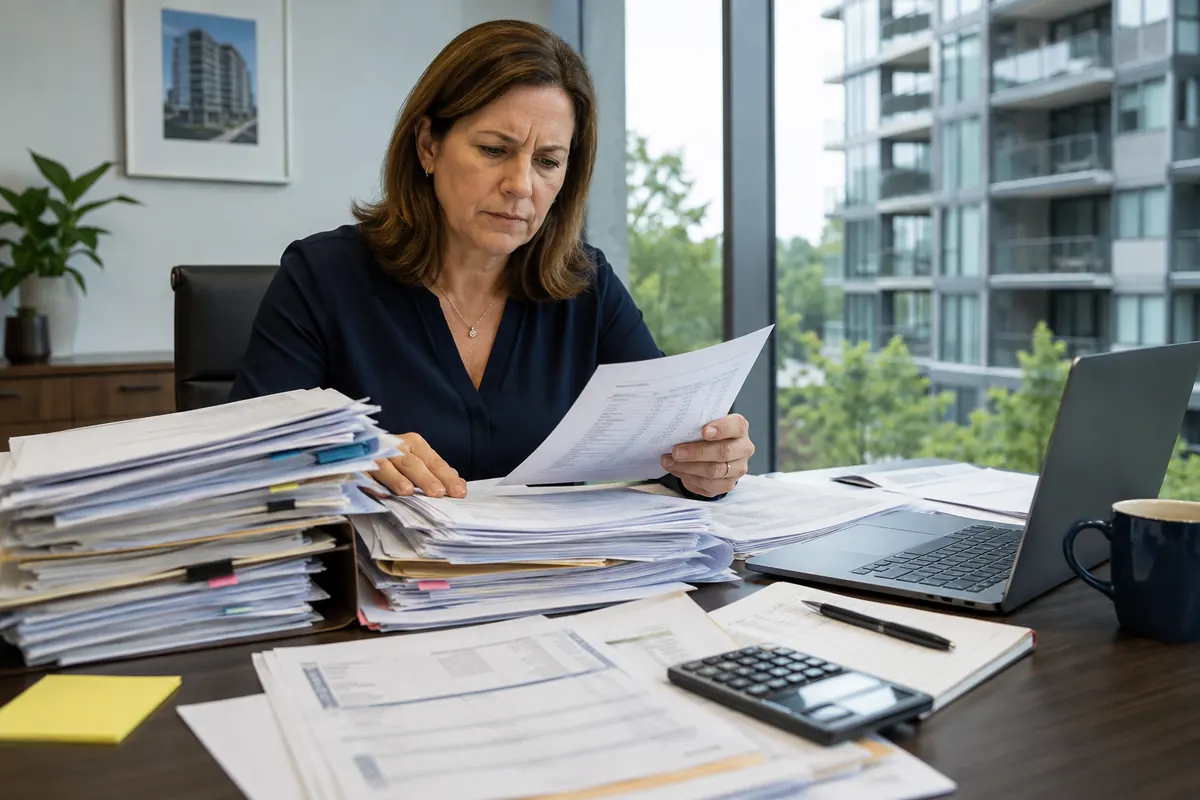
Ontario condo audits often slow down before the real audit review begins. The problem is not only judgment — it is document collection, GL matching, account mapping, owner receivables, and rebuilding the same file structure every year.
Why Ontario Condo Audits Get Stuck Before the CPA Even Reviews the File
For many CPA firms, the hardest part of an Ontario condominium audit is not the final opinion. It is getting the file ready. Before the CPA can review evidence, apply judgment, and sign the report, someone has to collect the documents, check completeness, read the general ledger, match bank activity, map accounts, test owner assessments, review receivables, prepare working papers, and assemble draft statements. That preparation layer is where condo audit files often get stuck.
The audit file starts messy
A typical condo audit does not begin with one clean package. It begins with emails. The property manager sends some bank statements. The board minutes arrive later. The budget is in one folder. Invoices are missing. The general ledger is exported from management software. Prior-year statements are in PDF. The AR aging may not agree cleanly to the trial balance. Every missing item creates another follow-up. Every follow-up delays the file. For CPA firms doing multiple condo audits in the same season, this becomes a capacity problem. The issue is not that the firm cannot do the audit. The issue is that the team loses too many hours before the audit work is ready for review.
Where the Ontario condominium audit hours go
The time usually disappears into five areas.
First, document collection. Staff chase bank statements, invoices, budgets, minutes, reserve documents, prior-year financial statements, and owner receivable reports. Second, GL and bank matching. The team compares ledger activity against bank records and support. Most transactions are routine, but each one still needs to be sorted, matched, or investigated. Third, account mapping. Condo account names often come from property-management systems, not from clean financial-statement headings. Repairs, reserve expenses, utilities, management fees, insurance, and receivables need to be mapped into the right statement lines. Fourth, owner assessment testing. Condo revenue is not ordinary sales revenue. It connects to units, monthly fees, arrears, owner balances, special charges, and budgeted assessments. Fifth, working paper and report preparation. Once the numbers are confirmed, the file still needs working papers, review notes, client questions, draft statements, letters, and final package assembly.
None of this removes the need for CPA judgment. It simply consumes time before judgment can happen.
Why generic audit tools do not fully solve it
General audit software is useful for trial balances, working papers, signoffs, and reporting. But condo audit work has a niche middle layer. The firm still needs to handle property-manager uploads, condo-specific document checklists, owner assessment testing, reserve fund presentation, invoice-to-GL matching, and condo-style final packages. That is why many firms end up with two systems: a general audit file on one side, and spreadsheets/email/manual schedules on the other. The gap between those two systems is where the hours go.
How Condo Audit Pro helps
Condo Audit Pro is built specifically for condominium corporation audit workflows. The platform gives property managers and boards one place to upload documents. The CPA team verifies those documents inside the audit file. The system helps extract data, compare GL activity, build the trial balance workflow, map accounts, organize owner assessment testing, prepare working papers, generate reports, and deliver the final package. The goal is not to replace the CPA. The goal is to reduce the mechanical preparation work around the CPA. Condo Audit Pro follows a simple rule:
The platform prepares. The CPA decides.
What this changes for CPA firms
When the preparation layer is organized, the audit file moves faster. Documents are easier to track. Missing items are visible earlier. GL matching becomes exception-based. Account mapping can carry forward. Trial balance numbers feed the rest of the file. Working papers and reports are assembled from confirmed data instead of being rebuilt manually. That means the CPA can spend more time on evidence, risk, conclusions, review, and opinion — and less time chasing the file into shape.
The bottom line
Ontario condo audit work is repeatable, but it is not simple. The firms that increase capacity are not cutting corners on judgment. They are reducing the time spent on document chasing, matching, mapping, and rework.
That is the part Condo Audit Pro is built to fix.
Written by the Condo Audit Pro team. Our audit logic was built over more than a year with a retired Canadian CPA — shaped from real published condominium and strata financial statements, reserve fund studies and depreciation reports, and each province’s legislation. More about how we built it.
The platform that prepares the file. The CPA decides.
Built for condominium and strata audits across Alberta, BC, and Ontario. Document collection, GL matching, two-fund classification, fee testing — handled before the CPA opens the file.