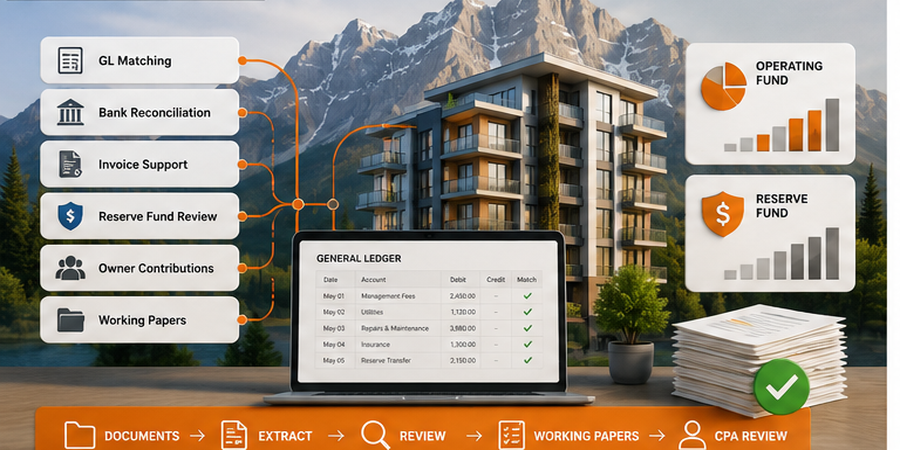
Alberta condominium audits lose time in the same places: tying the ledger to the bank and the trial balance, supporting invoices, and rebuilding the reserve fund story. Here is how to make that work exception-based without reducing CPA judgment.
An Alberta condo audit has a familiar rhythm. The CPA firm needs the general ledger, trial balance, bank statements, invoices, board minutes, budget, reserve fund study and plan, prior-year statements and owner balances. Once those arrive, the real work is not only reading them. It is connecting them: the ledger to the trial balance, the ledger to the bank, invoices to expenses, and reserve fund activity to the plan and the separate reserve bank account. On one file that is manageable. Across a season of condominium engagements, it becomes a capacity problem.
Key takeaways
- GL matching is slow because the team checks hundreds of routine lines to find a handful of exceptions.
- Tie the trial balance to the ledger account by account before any substantive testing; a difference there affects everything downstream.
- Alberta's rules require a separate reserve fund bank account, a reserve fund study, a board-approved reserve fund plan and an annual reserve fund report, which give the audit clear points to test.
- Reserve fund errors often show up as a bank-versus-ledger difference, such as reserve interest posted to operating.
- Proposed adjustments should come from the differences found, with the CPA deciding on each one.
Why GL matching is the biggest time sink
Most condominium ledgers run to hundreds or thousands of lines. Many are routine: management fees, utilities, insurance, cleaning, repairs, bank charges, reserve transfers and owner payments. Routine does not mean automatic. Someone still has to compare the ledger to the bank and to support, and sort what agreed, what agreed only in part, what cleared after year-end, what belongs to another period and what has no support at all.
Done by hand, that is slow because the effort goes into the many lines that agree rather than the few that do not.
Start with the trial balance tie
Before testing anything, foot the trial balance and agree each account to the ledger. If the trial balance does not balance, or an account on the trial balance differs from the ledger total, every schedule built from it inherits the problem. Say a repairs account shows 20,000 on the trial balance but the ledger supports 18,500: that 1,500 needs an explanation before you sample a single repairs invoice.
Then the bank
Compare each bank statement to its cash account in the ledger, month by month. Differences between the bank and the ledger are often the fastest way to find misposted transfers, unrecorded charges and items in the wrong fund.
Then invoices
For sampled expenses, match the invoice to what was posted: amount, date, payee and account. A posting that is a transposition of the invoice amount, or an invoice recorded on one side only, will surface here rather than at review.
Reserve fund work adds another layer
Alberta condominium files are not ordinary small-business audits, because the reserve fund carries its own rules. The Government of Alberta states that a corporation must keep its reserve fund in a separate bank account, apart from its other funds, and that managers handling corporation money must follow the same rule. A reserve fund study must be done at least every five years, and the board approves a reserve fund plan based on it. The corporation must give owners a copy of the approved plan before implementing it, and provide an annual report on the reserve fund. For more on the study itself, see our article on the reserve fund study in Alberta.
The province also says the reserve fund is for major repair and replacement of common property, not ongoing maintenance, and may fund capital improvements only if they are in the reserve fund study or approved by special resolution. Check the current rules before relying on any specific threshold or timing.
Procedures that follow from those rules
- Reconcile the reserve bank and investment accounts to the reserve fund balance in the ledger, and confirm them directly with the institutions.
- Agree reserve contributions to the approved budget and the reserve fund plan.
- Test reserve expenditures against the plan, and against a special resolution where the spending is a capital improvement.
- Check that interest earned on reserve investments was recorded in the reserve fund.
- Agree the closing reserve balance to the annual reserve fund report given to owners.
A hypothetical example
Say a 40-unit building's reserve bank account shows 100,000 at year-end while the reserve fund in the ledger shows 95,000, and the operating account is 5,000 higher in the ledger than at the bank. The two differences are equal and opposite. A likely cause is reserve interest or a reserve transfer posted to the operating fund. Finding it is mechanical; deciding on the correcting entry and whether it signals a control weakness is the CPA's call.
Why the same file gets rebuilt every year
A lot of Alberta condominium audit time goes into rebuilding what the firm already knew last year: the document checklist, the opening fund balances, the comparatives, the unit factors and the same reserve fund schedules. The building has not changed much, but the workflow starts from scratch. That is frustrating for staff and costly for the firm. Our Alberta condo audit checklist sets out the documents worth requesting up front.
How Condo Audit Pro helps
Condo Audit Pro reads the trial balance, general ledger and bank statements from Excel, CSV and bank PDF statements. It foots the trial balance and ties it to the general ledger account by account, compares bank statements to the cash accounts and matches sampled invoices to what was posted. From the differences it finds, it proposes adjusting entries; the CPA accepts or dismisses each one, and nothing is recorded automatically.
For the reserve fund, the financial statements are fund-based, operating and reserve, with Alberta wording, and confirmations for the bank, reserve, loan and legal are set up from the trial balance with status tracking. In the second year, openings, the unit roster and last year's answers come forward as suggestions to confirm. See how this works for Alberta files.
Common questions
What should be tied first in a condo audit?
The trial balance to the general ledger, account by account. A difference there flows into every later schedule, so resolve it before sampling.
Does an Alberta reserve fund need its own bank account?
Yes. The Government of Alberta states the reserve fund must be kept in a separate bank account, apart from the corporation's other funds.
How often is a reserve fund study required in Alberta?
The province says at least every five years. Check the current rules for timing on newer buildings and for any changes.
Who decides on proposed adjusting entries?
The CPA. Differences can be found and an entry proposed, but each entry is accepted or dismissed by the CPA before anything is recorded.
GL matching and reserve fund work are where Alberta files lose time, and they are also where structure helps most. Watch a complete Alberta audit walkthrough, or book a demo to see it on your own file.
Written by the Condo Audit Pro team at Yabuh Ltd. The platform is the result of 1,000+ hours of development, and its audit logic is built on Canadian Auditing Standards (CAS), ASNPO and each province’s condominium statute. The firm’s own CPA performs and signs the audit. More about how we built it.
The platform that prepares the file. The CPA decides.
Built for condominium and strata audits across Alberta, BC, and Ontario. Document collection, GL matching, two-fund classification, fee testing — handled before the CPA opens the file.